
ER doctors with 1099 income frequently ask us if forming an S corp will cut their tax bill.
Every situation is unique, but in our experience, S corps are vastly overrated. When you perform an honest, low-risk calculation, the advertised savings usually vanish.
This guide explains S corp mechanics and outlines a simple three-step process to determine if an S corp actually makes sense for you.
S Corp Basics
Without an S corp, you pay payroll tax (called self-employment tax) on all of your 1099 earnings.
If you elect S corp taxation, you split your 1099 earnings into two buckets:
Wages for working as an employee of your S corp (subject to payroll tax).
Profit distributions for owning your S corp (NOT subject to payroll tax).
This structure creates an incentive to declare lower wages to minimize payroll tax.
S Corp Analysis: Three Steps
Determining whether an S corp works for you requires evaluating three factors in order:
Risk: Decide how aggressive of a wage you are comfortable defending.
Savings: Calculate if an S corp actually saves you money at that wage.
Hassle: Decide if any savings justify the ongoing administrative friction.
Step 1: Risk
The IRS is well aware that lower wages reduce payroll taxes. So, they require you to pay yourself “reasonable compensation.”
Reasonable compensation is evaluated case-by-case. If audited, the burden of proof is on you to justify your wage.
Solid evidence supports an S corp wage of $153 an hour for an ER physician. (Source: Bureau of Labor Statistics nationwide ER physician W-2 employee mean wage, May 2025.)
At $153 an hour, you have a defensible, low-risk wage. If an S corp yields substantial savings at this rate, it may be worth pursuing. If it doesn't, you would have to test lower wages, which introduces more risk.
Step 2: Savings
To see if an S corp saves money, compare your total cost with and without it.
This requires modeling your complete tax landscape. With an S corp, payroll tax may be lower, but federal income tax is often higher.
Case Study Comparison
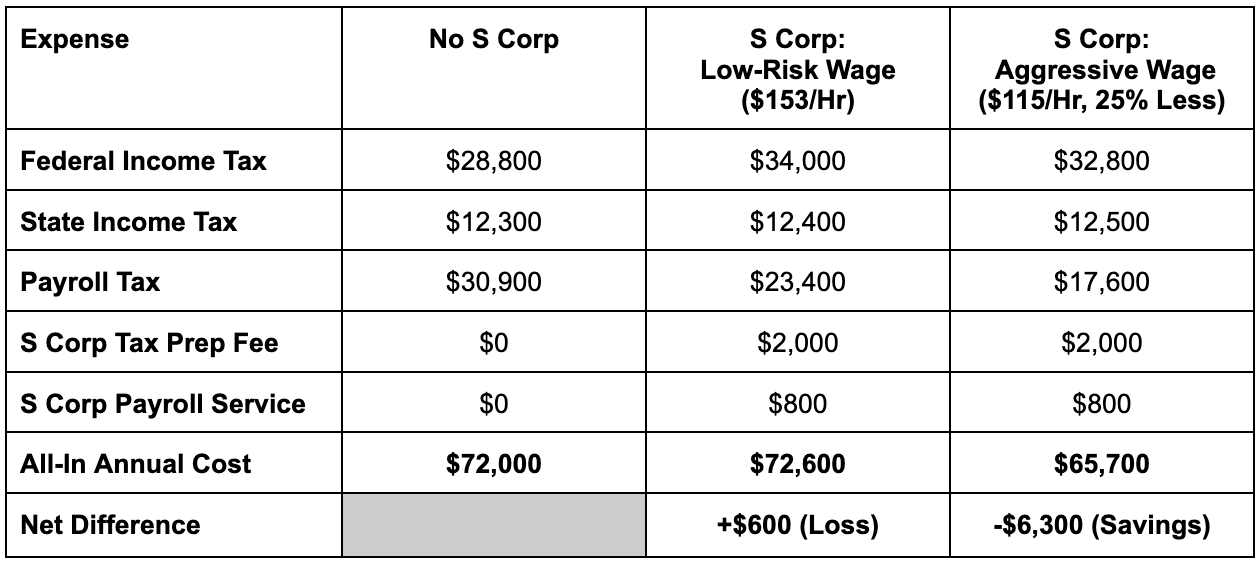
Assumptions: $300,000 of 1099 earnings (1,000 hours at $300/hr); $30,000 retirement contribution; no W-2 income; married filing jointly (spouse has no earned income).
The Takeaway:
At the low-risk wage ($153/hr), the S corp costs $600 more per year than doing nothing.
At the aggressive wage ($115/hr, which is 25% lower than the low-risk wage), the S corp saves $6,300. However, $115/hr is difficult to defend—few ER docs would accept $115/hr shifts—and even $6,300 in savings rarely justifies the operational burden.
This is just one simple example. Individual situations involve many variables. However, in our experience, an S corp rarely—if ever—makes sense at a defensible, low-risk wage like $153 an hour.
Step 3: Hassle
Even when an S corp shows modest paper savings, the operational friction often outweighs the benefit.
An S corp introduces ongoing administrative overhead:
Forming and maintaining a state business entity.
Filing an election with the IRS to be taxed as an S corporation.
Maintaining a business bank account and strict accounting hygiene.
Running regular payroll and withholding appropriate taxes.
Keeping cash in the business bank account for payroll and retirement contributions while still meeting personal cash flow needs.
Preparing and filing a separate S corp tax return annually.
Reevaluating the S corp annually as your situation changes.
All of this takes time and mental energy. The complexity of an S corp is exactly the opposite of the simplicity and peace of mind most physicians are looking for!
Conclusion
Because S corp math has so many moving parts, the real answer comes down to a side-by-side comparison.
You deserve a clear, data-driven answer for your exact situation.
Schedule a Free 15-Minute S-Corp Analysis to run your numbers through our tax model and see where you stand.
This article is for general educational purposes only and is not tax, legal, or investment advice. It does not consider your individual circumstances, and you should consult a qualified tax professional before making decisions about entity structure or compensation. The case study is a hypothetical illustration, not a projection or guarantee of results.
